

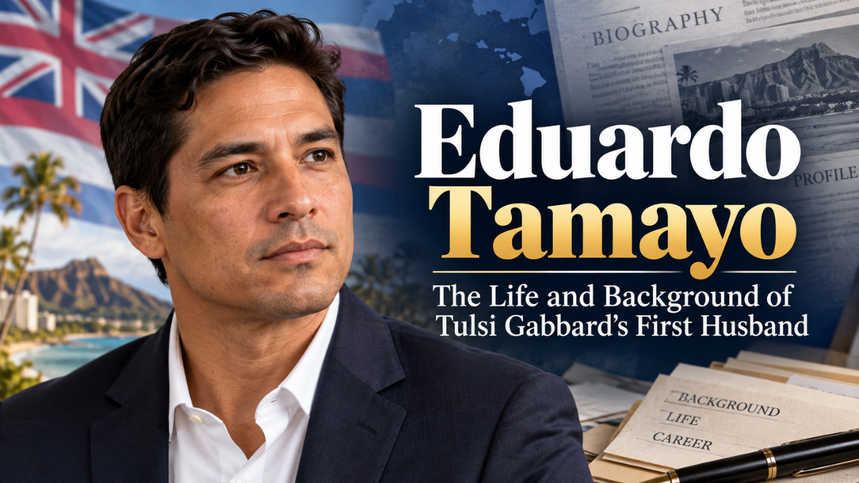
A familiar name in politics can make people curious about someone who was part of that person’s life long before the headlines. That’s how many readers encounter Eduardo Tamayo.
Tamayo was Tulsi Gabbard’s first husband. The couple got married in 2002 but separated in 2006, during a time when Gabbard was also serving in the military overseas. The New Yorker Yet those dates only tell us when the marriage began and ended. Her later comments reveal something more personal: a relationship built on friendship, followed by a separation she described as painful.
There’s enough documented history to understand that relationship. There’s much less reliable information about Tamayo’s wider life, and keeping that distinction clear makes his story easier to follow.
Table of Contents
- Who Is Eduardo Tamayo?
- A Friendship Before the Headlines
- Marriage During a Changing Chapter
- The Strain of Military Separation
- Why Gabbard Kept the Tamayo Name
- A Connection After the Divorce
- What’s Known About His Work
- His Age, Education, and Net Worth
- Where Is Eduardo Tamayo Now?
Who Is Eduardo Tamayo?
Eduardo Tamayo became known to the public mainly because of his previous marriage to Tulsi Gabbard. She has also referred to him as Eddie, so readers may encounter both names in accounts of the relationship.
He shouldn’t be confused with Abraham Williams, the cinematographer Gabbard married in 2015. Tamayo was part of an earlier period in her personal life.
Most reliable details about him come from news reports about Gabbard, rather than interviews in which Tamayo shares his own story. That gives readers a useful starting point, but also a limited view.
Knowing who someone married doesn’t tell us everything about who they are. It establishes a connection. Their personality, ambitions, and everyday life require their own evidence.
A Friendship Before the Headlines
In a 2013 interview with Vogue, Gabbard described Tamayo as her childhood sweetheart. She shared memories of surfing together, being close friends, and growing up in families that knew each other well.
That’s an appealingly ordinary beginning. A shared activity, familiar families, time spent together: many relationships grow from exactly those things.
Her recollection suggests a bond that developed through familiarity. Still, it’s a brief memory, not a complete account of their childhood. We don’t have enough detail to recreate their first meeting or the moment friendship became romance.
Marriage During a Changing Chapter
Their wedding year, 2002, also marked Gabbard’s election to Hawaii’s House of Representatives. Vogue Looking back, it’s easy to see that year through the lens of her later political career. At that point, her career in public office was just beginning.
A January 2004 legislative directory in The Honolulu Advertiser listed her as Tulsi Gabbard Tamayo and named Eduardo as her spouse. That contemporary record places the marriage within her working life as a state legislator.
Those small details help fix the chronology. Tamayo was an important part of her personal life during the early stages of her political career.
It would be tempting to imagine how they balanced marriage with public responsibilities. But the available accounts don’t describe their household routines or private conversations. We can identify the overlapping commitments without pretending to know how every day felt.
The Strain of Military Separation
Gabbard later shared that the challenges of serving in Iraq had put pressure on their relationship, eventually contributing to their divorce. In a statement reported by Honolulu Civil Beat in 2011, she said the approximately 18-month absence had been difficult for Tamayo and their relationship. She placed that experience within the wider pressures faced by military spouses and families.
Think about what a long separation can mean in everyday terms. A partner misses ordinary dinners, birthdays, difficult workdays, and all the small conversations that usually happen without planning. That’s a general example, not a description of specific events in their home.
Distance can change the texture of a relationship.
Gabbard’s account helps explain the circumstances surrounding the divorce, but it remains her perspective. It doesn’t give us Tamayo’s full account or establish every private reason the marriage ended.
The fair reading is that she described deployment-related separation as a serious strain. Turning that explanation into a judgment about either spouse would go beyond what she actually shared.
Why Gabbard Kept the Tamayo Name
One detail can make older records confusing: Gabbard continued using Tamayo after the divorce.
A 2009 Senate Veterans’ Affairs hearing transcript identifies her as Tulsi Gabbard Tamayo. The name’s appearance in that document shouldn’t be read as proof that the marriage was still intact.
In 2011, she announced that she was returning to her maiden name. Civil Beat reported that she had retained the married surname because she’d hoped reconciliation might be possible.
That explanation adds an emotional detail to an otherwise dry timeline. A legal ending and someone’s hopes for a relationship don’t necessarily move at the same pace.
For anyone reading an old article, the practical point is simple: check the event date as well as the name being used. A surname can remain in professional records after someone’s marital circumstances change.
A Connection After the Divorce
Gabbard’s later statement, reproduced by The Times of India, said that she and Eddie remained friends and that his family continued to welcome her. Those comments describe the relationship as she presented it in 2011.
There’s also a separate, concrete record of contact with her political world. According to a February 2012 report by Honolulu Civil Beat, Eduardo Tamayo donated $520 to Gabbard’s congressional campaign.
The contribution establishes financial support at that point. It doesn’t explain his reasons, tell us whether he helped with campaign activities, or reveal his views on every political issue.
Taken alongside her earlier comments, it suggests that divorce hadn’t erased every connection between them. That’s a modest conclusion, but a meaningful one.
Relationships can continue in different forms after marriage ends. The public record offers a glimpse of that possibility here without telling us what their relationship looks like today.
What’s Known About His Work
There is one straightforward contemporary detail about Tamayo’s employment. The Honolulu Advertiser’s 2004 legislative directory described Gabbard’s spouse, Eduardo, as self-employed.
The entry doesn’t name a company or explain his industry. “Self-employed” can cover many kinds of work, so it doesn’t support a detailed story about business ventures or investments.
A separate historical donation form held by the Federal Election Commission lists an Eduardo Tamayo as a self-employed graphic artist. However, that form doesn’t identify the donor as Gabbard’s husband. The matching name alone leaves an identification question.
Here’s the thing: a plausible connection still needs confirmation.
The newspaper directory gives us a clear fact about her spouse’s work status at that time. It can’t establish what he does now, how successful his work became, or whether he later changed fields.
His Age, Education, and Net Worth
Questions about Tamayo’s age, qualifications, and finances are understandable. They’re also areas where the reliable reporting discussed here provides few answers.
His exact birth date isn’t established by these sources. Gabbard’s birthday appears in the 2004 legislative directory, but that information belongs to her. It can’t be used to calculate her former husband’s age.
The same care applies to education. A degree or professional qualification needs a source clearly identifying the right person. A matching name on a career profile isn’t enough.
As for net worth, there isn’t a dependable estimate in the sources examined here. Self-employment and a campaign contribution don’t provide the financial information needed to calculate someone’s wealth.
Let’s be honest, a precise number can look convincing even when its foundations are weak. Before accepting one, look for an explanation of where it came from. Repetition across websites doesn’t supply the missing evidence.
Where Is Eduardo Tamayo Now?
The available reliable accounts don’t give a clear, current picture of Tamayo’s residence, work, or family circumstances. They document parts of an earlier relationship and a few later appearances in the public record.
An old employment entry can’t answer what someone does today. A comment about friendship in 2011 can’t establish how often two people speak now.
That lack of information doesn’t tell us why Tamayo receives little coverage. It simply means we should leave room for a life that these sources don’t describe.
His documented connection to Gabbard remains understandable without filling those gaps: they shared a childhood friendship, married, and later separated during a difficult period she associated with military deployment. The most useful takeaway is to read that history on its own terms. It contains a human relationship, with affection and disappointment, while leaving much of Tamayo’s personal story outside public view.