

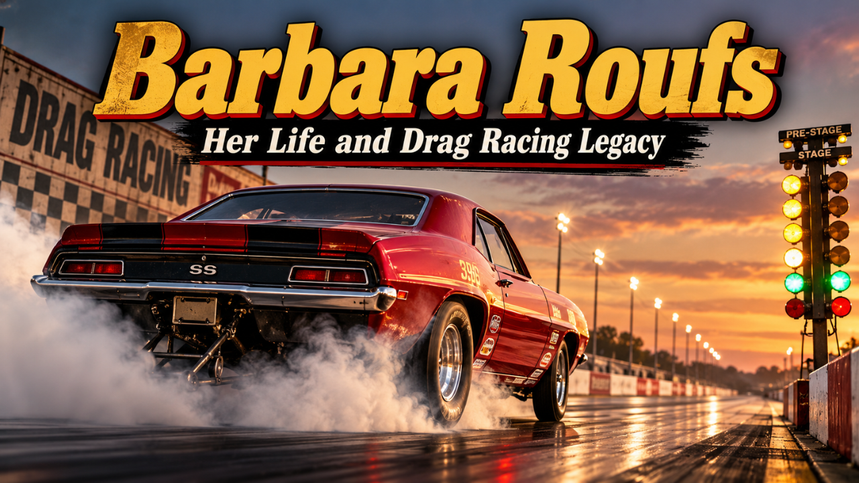
An old racing photo can catch your attention for reasons that have almost nothing to do with the car itself. You notice a smile, a familiar face, or the clothes people wore before the picture became a piece of history. Then you start wondering about the person standing beside the machine.
For many readers, that’s how Barbara Roufs’ story begins.
Barbara was a trophy queen associated with California’s early 1970s drag racing scene. Her photographs have outlasted the events they captured, introducing her to people who weren’t born when she appeared at the tracks. Those pictures explain her lasting appeal, but they reveal only part of her life.
Behind the recognizable image was a woman with family connections, a public role in a lively sporting community, and a personal history that remains unevenly documented.
Table of Contents
- Who Was Barbara Roufs?
- The Racing World Around Her
- What Being a Trophy Queen Meant
- The Style People Still Recognize
- Tom West and the Photographs That Survived
- Her Family Beyond the Racetrack
- Sorting Out Her Birth Date and Age
- What Is Known About Her Death
- Why Barbara Roufs Still Matters
Who Was Barbara Roufs?
Barbara Roufs was an American trophy girl and promotional personality remembered for her appearances around drag racing. One of the clearest details in accounts of her career is her title as the 1973 Professional Dragster Association queen, often shortened to PDA queen.
Her role belonged to the ceremonies and publicity surrounding the races. She presented trophies and appeared in photographs connected with the sport.
That distinction helps explain what you’re looking at in an old photograph. Someone standing beside a racing car might be a driver, mechanic, sponsor, or guest. Barbara’s place in these images came through her work as a race queen.
The title gives her an identifiable place in racing history. It connects her name with an organization and a year, offering a useful starting point for anyone who recognizes her face and wants to understand where she belonged.
The Racing World Around Her
Orange County International Raceway is an important setting in accounts of Barbara’s career. Tuko.co.ke Known as OCIR, the California track opened in August 1967 and operated until 1983. NHRA’s history describes a venue designed to make attending a race more comfortable and professional, with permanent facilities and a distinctive timing tower.
This was a place built around the whole spectator experience. The cars mattered, of course, but so did the setting, the crowds, and everything happening between runs.
The track also hosted ambitious events. In May 1973, its Big Four Constructors Championship brought together a 32-car Top Fuel field organized around engine builders and independent teams. That gives a useful glimpse of the racing environment during Barbara’s most recognizable period.
Picture a fan leaving with a race program and a few photographs. Years later, those souvenirs may preserve just as much about the people at the track as they do about the race results. Barbara’s story fits into that wider memory.
What Being a Trophy Queen Meant
The term “trophy girl” can sound rather narrow today. At racing events, the role put women into award presentations and promotional photographs, linking their public image with the occasion. Barbara’s career is described in that context.
There was a practical reason for those appearances. A presentation gave photographers a moment they could capture: a winner, an award, and people gathered to mark the achievement. It turned the end of a race into a picture someone could keep.
Detailed public accounts of her working arrangements are scarce. Her photographs and reported title establish a public presence, while questions about her schedule, pay, and daily responsibilities remain open.
Even with those limits, the role explains why she appears in racing history. Sporting events leave behind images of many people whose contribution never appears on a results sheet.
The Style People Still Recognize
Barbara’s long hair and tall boots feature prominently in descriptions of her appearance. They place her photographs firmly within the fashion of the period.
Clothes can make an old image feel surprisingly immediate. You might struggle to identify a car’s engine or chassis, yet recognize the decade from a pair of boots. That’s part of the appeal of vintage racing photography: it offers several ways into the same scene.
The clothes, the setting, and her expression work together. You’re seeing a person within the public style of her time, and that context helps explain why the images continue to catch people’s attention.
I think the more interesting detail is how readily a person can become associated with an era through photographs. A hairstyle, an expression, and a trackside setting can stay recognizable long after the original event has faded from memory.
Tom West and the Photographs That Survived
Photographer Tom West is central to Barbara’s surviving public image.A memorial shared on CorvetteForum says he photographed her in 1971, 1972, and 1973. In that recollection, he described her warmly as a friend and someone who was pleasant and cooperative to photograph.
Because this is a reproduced tribute, it should be understood as an attributed personal recollection. Even so, it adds something valuable: a sense of the working relationship behind the images.
A photograph freezes an expression. A photographer’s memory can offer a little context about the person making it.
Later reporting describes renewed interest in West’s pictures around 2016 and identifies Barbara’s daughter, Jet Dougherty, as someone who responded to them.
Imagine finding a photograph of your mother that you’d never seen, surrounded by comments from strangers who remember her. For a family, that discovery could carry a very different meaning from the nostalgia felt by a racing fan. It helps explain why these pictures deserve more attention than a quick repost.
Her Family Beyond the Racetrack
A useful family source is the obituary of Barbara’s mother, Thelma Ruby Riley, published by the Fresno Bee in June 2005. It names Barbara Roufs as a daughter who had already died. The obituary also records Thelma’s long-running beauty salon in Clovis and her work as a church organist.
There’s a connection with motorsport, too. The same notice says Thelma rode motorcycles with her husband, Wayne, and raced at Kearney Bowl.
The obituary also names Vivian Deaton, James Riley, Bruce Riley, and Ben Gube among Thelma’s children. These details connect Barbara with a family whose life extended well beyond the racing photographs.
Jet Dougherty is identified as Barbara’s daughter in later biographical reporting. Briefly.co.za Beyond that, accounts of Barbara’s marriage and children are inconsistent enough to make a complete family portrait difficult.
What these sources offer is a glimpse of an ordinary family world alongside the public photographs: work, relatives, local activities, and relationships that mattered beyond race weekends.
Sorting Out Her Birth Date and Age
Barbara’s birth year is one of the details that causes confusion. Some popular biographies give 1944. An Ancestry listing drawn from the Find a Grave index records Barbara Jean Riley Roufs as born on July 22, 1943, in Clovis, California, and as having died on January 25, 1991, in Fresno.
Those indexed dates would make her 47 when she died. They also explain why the frequently repeated combination of a 1944 birth year and a January 1991 death at 47 doesn’t fit.
The memorial index supports 1943 as her birth year. Taken together, its dates place her around 30 during the year of her reported PDA queen title, helping put her racing appearances into perspective.
This may seem like a small point, but dates shape the whole timeline. Once one incorrect year gets repeated, later accounts can start placing someone at the wrong age during important events.
What Is Known About Her Death
Barbara Roufs died in January 1991, according to the memorial index and later biographical accounts. Her death is reported as suicide in secondary coverage, while the personal circumstances remain poorly documented in the available sources.
That leaves questions readers may understandably have, but the photographs can’t answer them. A cheerful expression at a racing event years earlier offers no reliable explanation of someone’s later private life.
There’s no sound reason to attach an invented motive to her death. Doing so would turn an incomplete record into a story that only appears complete.
The loss belongs in her biography. It also deserves proportion. Barbara had a life before that final event, including family relationships and the racing years through which so many people came to know her face.
Why Barbara Roufs Still Matters
Barbara’s story shows how unevenly public memory works. Sometimes photographs remain readily available while the everyday details of the person in them become difficult to recover.
For a racing enthusiast, her images offer a connection with a particular sporting scene. Someone interested in photography or fashion may notice different details. A family member might see an expression that brings back a personal memory.
Those responses can exist together.
The most useful way to remember Barbara Roufs is to keep her documented racing role, the surviving recollections, and the gaps in her biography in view. Her place in drag racing’s visual history is enough to make her worth remembering. The pictures invite curiosity; careful attention helps preserve the person behind them.