

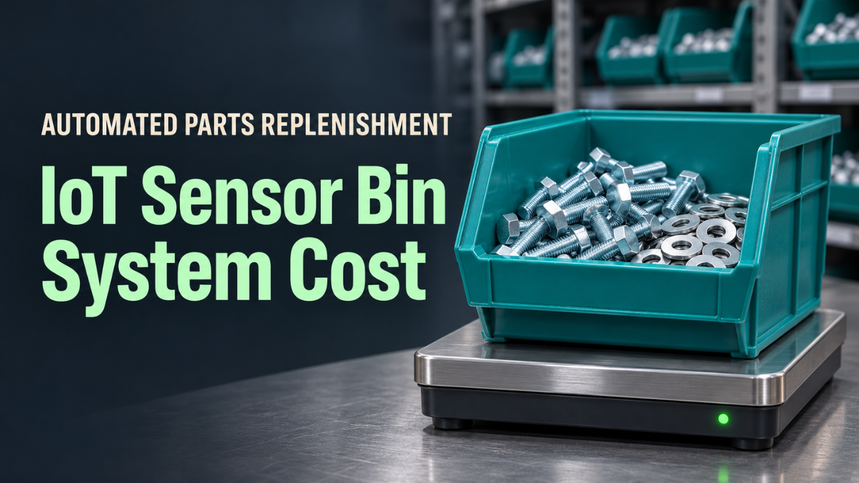
The last bag of washers comes out of the bin on Thursday afternoon. By Friday, someone’s paying for overnight delivery of parts that normally cost a few cents each. Once that happens a couple of times, a bin that can tell you when it’s running low starts to look like a sensible purchase.
For a 24-bin stockroom, one straightforward setup comes to about $9,000 in the first year, using U.S. prices. The sensor is the easy part to price. Some entry-level weight sensors are listed at around $100 per monitored bin.
Table of Contents
- How a smart bin triggers a reorder
- What the hardware and software cost
- A first-year budget for 24 bins
- Where setup costs creep in
- When your parts supplier runs the bins
- How to tell if the bins will pay for themselves
How a smart bin triggers a reorder
A connected scale sits under the bin and sends weight readings to the inventory software. The software subtracts the empty bin’s weight and uses the weight of a single part to estimate how many are left. When the count reaches the reorder point you’ve set, the system can alert a buyer or trigger an order.
Say your shop uses 20 shaft collars a day and the supplier usually delivers in three working days. A reorder point of 80 covers the 60 you expect to use while you wait, with 20 extra in case a delivery slips or a shift uses more than usual. Revisit that number if your supplier changes its delivery schedule. A perfectly accurate sensor will still send the alert too late if the reorder point is set too low.
Check what actually triggers a reorder on the equipment you’re considering. An infrared bin can send a low-stock signal by itself. In a two-bin RFID setup, a worker may put the empty bin in a reader enclosure to request a refill while the second bin stays in use.
What the hardware and software cost
Start by counting the locations you need to monitor. One part number stocked in a storeroom and on two assembly lines may need three sensors. Also check whether you can keep your bins and shelving. A scale under an existing bin can make better use of what you already own, as long as the bin fits and the scale can register the changes in weight you need to track.
Price the scales against what you actually store. A bin of steel fittings needs enough capacity to hold a full load. For tiny nylon washers, the question is whether the scale can pick up the handful someone takes out on each trip. Give the vendor the weight of the lightest part and the weight of the heaviest full bin you want each scale model to handle.
Paragon Robotics lists inventory scales starting at $99 each. eTurns estimates SensorBins hardware at about $96 per monitored item and lists its Optimize plan at $399 per stockroom per month, billed semiannually.
A gateway collects readings from several sensors and passes them to the software. Component Solutions Group estimates $500 to $1,500 per gateway and $40 to $200 per bin for sensors. Its estimate for a per-bin subscription is $1 to $7 per bin per month.
Check the billing unit on each quote. A second room can raise the bill on a per-stockroom plan even if it uses sensors you already own. With per-bin pricing, ask if there’s a monthly minimum and check whether the quote includes the gateway and support.
A first-year budget for 24 bins
Picture one parts room with existing racks and a buyer who can work from low-stock alerts. The gateway, setup and upkeep amounts are allowances for this example. The hardware and software lines use eTurns’ published figures.
| Cost | When you pay | Budget |
|---|---|---|
| 24 sensor positions at $96 each | Up front | $2,304 |
| Gateway and mounting supplies | Up front | $700 |
| Installation, item setup and staff training | Up front | $900 |
| Software at $399 per month | Yearly total | $4,788 |
| Spare parts and routine upkeep | Yearly allowance | $300 |
| First-year total | $8,992 |
That’s $3,904 to get started and $5,088 a year to run the setup. At the same rates, three years come to $19,168. Add freight, taxes, new shelving or a custom purchasing integration where they apply.
Where setup costs creep in
A bench test is easy. Put that same bin on a rack beside a press and let somebody refill it during a busy shift. A bin rubbing against the shelf upright can shift some of its weight off the scale. A handful of almost identical screws tipped into the wrong bin still registers as weight. During setup, check the readings against hand counts with a full bin, a nearly empty one and one at the reorder point. That’s a good test for tiny clips or washers, where a small error in weight can mean a big difference in the reported count.
Then there’s purchasing. An alert that goes straight to a buyer’s inbox can be enough to get started. If you want the bins to raise orders in your enterprise resource planning system (ERP), budget time to match up item codes, delivery locations and approval rules.
A bin might need 70 screws when the supplier sells cases of 100. Decide whether the system should round up or send the order for review. It also needs to account for open orders so a bin that stays low for three days doesn’t generate three orders.
Put those details in the scope before comparing quotes. Ask the installer to test the gateway where it’ll actually sit. You’ll want to see what happens if it drops offline and how the buyer can tell the last reading is out of date. If it uses cellular data, check who pays for the data plan.
Someone also needs time to keep the bin settings current. Say you switch suppliers and the new bolts weigh a little more per piece. A full bin can look like it has more stock than it really does if the software still uses the old piece weight. Build a quick weight check into how you bring a replacement part onto the shelf.
When your parts supplier runs the bins
In a vendor-managed inventory arrangement, the supplier can monitor levels and refill the bins. Fastenal, for example, describes a setup where a low-stock alert goes to the local branch, which arranges a restock.
Read the parts pricing alongside the equipment proposal. Some suppliers recover the cost through a service fee or the price of the parts.
At 150,000 fasteners a year, an extra two cents per part adds $3,000 annually. Ask about minimum purchase volumes, who owns the equipment and who owns the stock before you use it.
The delivery schedule matters, too. If the supplier visits on Fridays, find out who handles a shortage flagged on Tuesday. A useful quote shows what routine restocking costs and what happens when you need a delivery between visits.
How to tell if the bins will pay for themselves
Start with the work you can measure. Spend a week tracking time spent counting parts, chasing shortages and creating routine orders. Pull the invoices for rush shipments and look at what you paid above the normal freight or purchase price. If downtime is part of the case, use delays you can reasonably tie to the bins you plan to monitor.
Suppose the 24-bin setup frees up three hours a week at a labor cost of $35 an hour. Across 50 working weeks, that’s $5,250 in staff time. Avoid six rush orders with a $250 premium each and you save another $1,500. Subtract the $5,088 in annual running costs and you have $1,662 a year in net benefits. At that rate, it takes about 28 months to recover the $3,904 you spent up front.
Run the numbers with two avoided rush orders a year and payback stretches to nearly six years. If staff stay on the same shifts, put a value on what they can do with the hours they get back. Keep those hours visible when you discuss the budget.
I’d start with the parts people check most often and the ones that keep showing up on rush orders. Follow a few real restocks and see whether the alerts give the buyer enough time to order on your usual terms. Keep a tally of the rush orders you actually avoid and use it to budget the next shelf.